
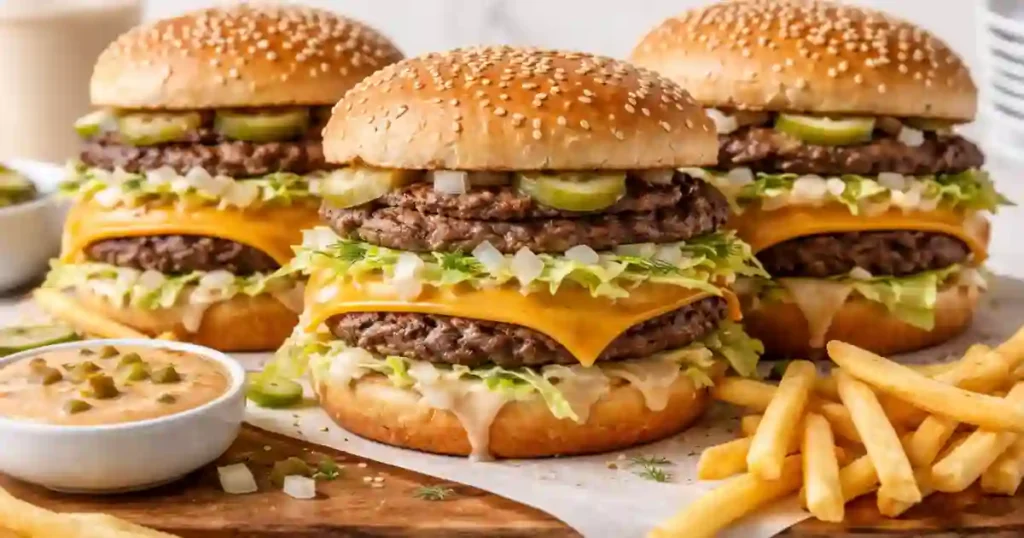
Copycat McDonald’s Big Mac: Why This Recipe Works
You’re probably here because you want a copycat McDonald’s Big Mac that actually tastes like the real thing. Not just close. Not “kind of similar.” But that unmistakable bite you remember. The one that somehow hits salty, tangy, creamy, and nostalgic all at once.
Let’s be honest for a second. Most homemade Big Mac recipes miss the mark. Either the sauce tastes off, the burger feels too heavy, or something just doesn’t click. It looks right, sure. But the first bite tells a different story.
This version works because it focuses on the details most people ignore. The balance of the sauce, the thinness of the patties, the layering order. Small things, but they stack up fast. And weirdly, once you notice them, you can’t un-notice them.
There’s also a bit of trial and error behind this. At one point, I thought using thicker, juicier patties would make it better. Turns out, that actually ruins the whole fast-food texture. It stops feeling like a Big Mac and starts feeling like… just another burger. Which is not the goal here.
Why You’ll Love This Copycat McDonald’s Big Mac Recipe
- Quick and easy to make in under 30 minutes, no drive through needed
- Uses simple, everyday ingredients you probably already have
- Delivers that nostalgic Big Mac flavor without leaving your kitchen
- Perfect for weeknight dinners, casual gatherings, or late-night cravings
- Customizable to your taste while still keeping the original feel
- A real crowd-pleaser that gets people talking after the first bite
There’s something oddly satisfying about recreating a copycat McDonald’s Big Mac at home and realizing… wait, this actually works. Not just visually, but flavor-wise too. It hits that same balance of tangy sauce, soft bun, and layered texture. Maybe even slightly better, depending on how you tweak it.
And honestly, it’s not just about the burger. It’s about that small moment when someone takes a bite and pauses for a second like, “Okay… this is legit.”
Copycat McDonald’s Big Mac: Why This Recipe Works
So what makes this copycat McDonald’s Big Mac different?
- It recreates the exact flavor balance, not just ingredients
- It respects the structure of the original burger
- It avoids overcomplicating things that should stay simple
And maybe more importantly, it gives you control. You can tweak it, push it, even improve it. But first, you need to understand what makes the original work.
What is a copycat McDonald’s Big Mac?
A copycat McDonald’s Big Mac is a homemade version of the classic fast-food burger made with two thin beef patties, a three-layer sesame bun, shredded lettuce, cheese, pickles, onions, and a signature tangy sauce designed to replicate the original flavor.
That’s the technical answer. But the real answer? It’s about recreating a very specific experience. And that’s where things get interesting.
Why do most Big Mac recipes fail?
Because they focus on ingredients, not behavior.
- They use thick patties instead of thin ones
- They overload the sauce or get the ratio wrong
- They ignore the bun structure
- They skip the textural contrast
And suddenly, it’s not a Big Mac anymore. It’s just a burger trying to cosplay as one.
You don’t need more ingredients. You need better decisions.
What Makes a Big Mac Taste Like McDonald’s
There’s something oddly specific about the flavor of a copycat McDonald’s Big Mac. It’s not gourmet. It’s not even complex in the traditional sense. But it sticks in your memory in a way that’s hard to replicate.
And here’s the part most people miss. It’s not just about ingredients. It’s about how those ingredients interact in very controlled, almost engineered ways.
Take the sauce, for example. People assume it’s just mayo and ketchup with some relish thrown in. That’s… not wrong, but also not right. The real magic sits in the balance. Slight sweetness, a bit of tang, a soft hit of acidity, and just enough salt to pull everything together.
Then there’s the texture. Actually, this might matter more than flavor.
- The patties are thin, almost fragile
- The lettuce adds a light crunch, not bulk
- The bun is soft, slightly compressed
- The middle bun creates separation between bites
It sounds minor. But remove one of these elements, and suddenly the whole thing feels off.
I used to think the cheese was a big player here. But after testing, it’s more of a background note. It melts into the burger and supports the flavor rather than leading it. Which is kind of surprising when you think about it.
The flavor profile breakdown
If you strip it down, a Big Mac works because it hits multiple taste signals at once:
- Sweet from the sauce
- Tangy from vinegar and pickles
- Savory from the beef
- Creamy from the mayo base
- Slight bitterness from lettuce
None of these dominate. That’s the point. It’s balanced in a way that feels effortless, even though it’s clearly not.
Why homemade versions feel “off”
Most homemade Big Macs fail for a simple reason. They exaggerate one element.
Too much sauce. Too much meat. Too much “improvement.”
And ironically, trying to make it better is what makes it worse.
There’s also this instinct to upgrade ingredients. Brioche buns, thick patties, fancy pickles. Sounds great, right? But that drifts away from the original experience. You’re not recreating a Big Mac anymore. You’re reinventing it.
Which is fine, but it’s a different goal.
If you want a true copycat McDonald’s Big Mac, you have to lean into its simplicity. Maybe even embrace the parts that feel a little underwhelming on their own. Because together, they do something unexpected.
Does the bun really matter that much?
Short answer, yes.
The three-layer sesame bun is not just for appearance. It controls structure, bite distribution, and even sauce spread. Without that middle layer, the burger collapses into something heavier and less balanced.
It’s one of those details that seems optional… until you try it both ways.
Copycat Big Mac Ingredients (What Actually Matters)
At first glance, the ingredient list for a copycat McDonald’s Big Mac looks almost too simple. And that’s exactly why it’s easy to mess up. When there aren’t many components, each one carries more weight than you’d expect.
You might be tempted to upgrade everything. Better beef, artisan buns, premium cheese. I’ve tried that route. It sounds logical, but the result drifts away from what makes a Big Mac feel like a Big Mac.
So instead of focusing on “better,” focus on “accurate.” That shift alone changes everything.
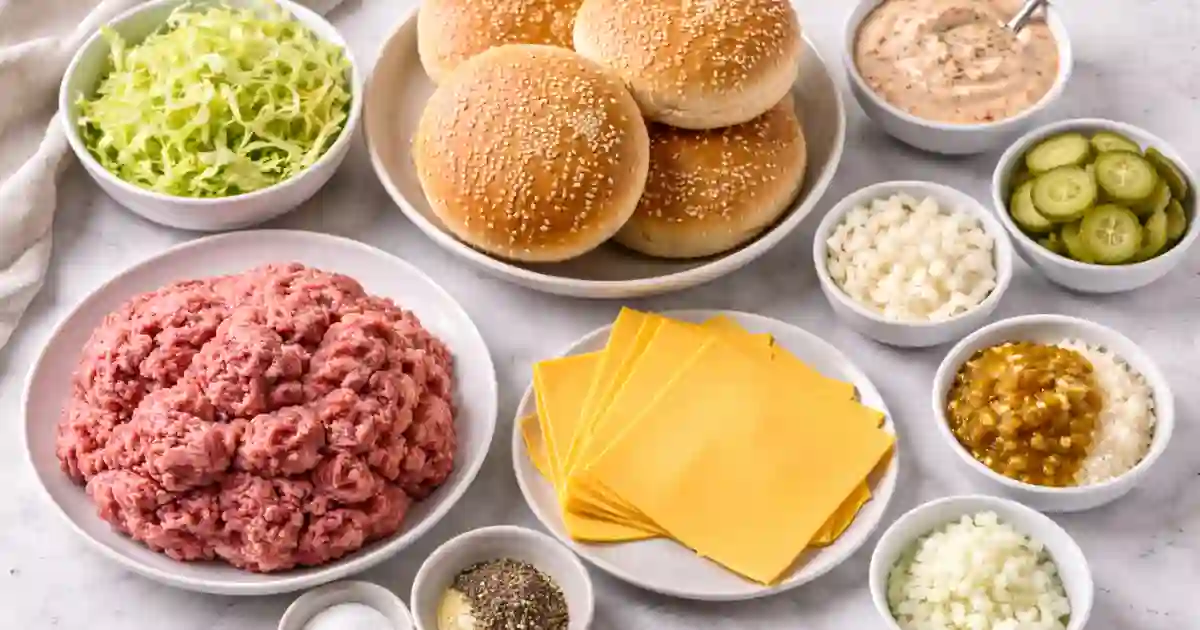
Here’s what you actually need:
- Ground beef (80 20 works best for flavor and texture)
- Sesame seed buns with a middle layer
- American cheese slices
- Finely shredded iceberg lettuce
- Dill pickles
- Finely chopped onions
- Big Mac style sauce
Now here’s where it gets interesting. Not all of these matter equally.
The ingredients that make or break it
Some components are non negotiable if you want that authentic taste:
- Thin beef patties
Thickness matters more than quality here. Too thick and the balance is gone. - American cheese
It melts differently. Other cheeses might taste better alone, but they don’t behave the same. - Iceberg lettuce
It’s not about flavor. It’s about that light crunch. - Pickles and onions
These bring acidity and sharpness. Skip or reduce them and the burger feels flat.
And then there’s the sauce. Honestly, this is where most of the identity lives. Get this wrong, and everything else feels slightly off, even if you can’t explain why.
What you can tweak without ruining it
Not everything is rigid. Some parts give you room to experiment:
- Bun brand and softness level
- Slight variations in pickle type
- Onion intensity
- Sauce quantity
Actually, scratch that last one. Sauce quantity feels flexible, but it’s easy to overdo. Too much and it overwhelms everything.
Why “better ingredients” can backfire
This might sound counterintuitive, but using premium ingredients can make your copycat McDonald’s Big Mac worse.
- Brioche buns are too rich
- Thick patties overpower the structure
- Sharp cheddar dominates the flavor
It becomes a different burger. Maybe a better one in some ways. But not a Big Mac.
And if your goal is to recreate that specific experience, accuracy beats creativity at this stage.
Can you substitute ingredients and still get close?
Yes, but with limits.
You can swap small things and still stay in the same flavor zone. But once you change structure or texture, the whole experience shifts.
A good rule of thumb:
- Swap flavors carefully
- Do not change structure
How to Make a Copycat McDonald’s Big Mac (Step by Step)
Alright, this is where things either come together… or quietly fall apart.
Because making a copycat McDonald’s Big Mac isn’t hard. But doing it in the right order, with the right timing, that’s where most people slip without realizing it.
Let’s walk through it cleanly.
Step by step instructions
- Prepare the sauce first
Mix your Big Mac style sauce and let it sit. Even 10 to 15 minutes helps the flavors settle. It tastes sharper at first, then smooths out. - Shape thin beef patties
Divide your ground beef into small portions and press them very thin. Almost thinner than you think makes sense. They will shrink slightly when cooked. - Cook the patties quickly
Use medium high heat. These cook fast, usually about 1 to 2 minutes per side. Season with salt and pepper during cooking. - Toast the buns lightly
Just enough to warm them and add slight structure. Not crispy. That’s important. - Build the first layer
Bottom bun
Sauce
Lettuce
Cheese
Patty - Add the middle bun layer
Place the middle bun, then repeat:
Sauce
Lettuce
Pickles
Onions
Patty - Top it off
Finish with the top bun and gently press everything together.
And that’s it. Sounds simple, right? It is. But also… not quite.
See how to make this recipe in the video below.
Why layering order matters more than you think
You might be tempted to freestyle this part. I did too.
But the layering controls how each bite feels. Sauce placement affects moisture. Lettuce placement affects crunch. Even the order of pickles and onions changes how the acidity hits.
It’s subtle, but noticeable.
How long does it take to make?
Realistically:
- Prep time: 10 to 15 minutes
- Cook time: 10 minutes
- Total: about 20 to 25 minutes
Which is honestly not bad for something that usually involves a drive through.
Can you make multiple Big Macs at once?
Yes, but it gets chaotic fast.
Cooking several thin patties, managing buns, and assembling layers at the same time can feel a bit overwhelming. If you’re doing more than two, it helps to stage everything beforehand.
Or accept a little mess. That’s part of the process.
Big Mac Sauce Recipe (The Real Secret)
If there’s one part of a copycat McDonald’s Big Mac that people obsess over, it’s the sauce.
And for good reason. It carries most of the identity. Without it, you’re just eating a layered burger. With it, suddenly everything clicks into place.
What goes into Big Mac sauce
Here’s a reliable base:
- Mayonnaise
- Sweet pickle relish
- Yellow mustard
- White vinegar
- Paprika
- Garlic powder
- Onion powder
Mix it until smooth. Then taste it.
Actually, pause here. Taste it before adjusting anything. Because this is where people start overcorrecting.
The balance you’re aiming for
The sauce should be:
- Slightly sweet, not sugary
- Tangy, but not sharp
- Creamy without feeling heavy
If it feels too flat, it usually needs a bit more vinegar or relish. If it’s too sharp, a touch more mayo softens it.
There’s no exact formula that works for everyone. And that’s kind of the frustrating part.
Why your sauce might taste wrong
Common issues:
- Too much mustard, making it harsh
- Not enough sweetness
- Skipping the resting time
And yes, resting matters. Give it at least 10 minutes. Longer is better.
Can you store Big Mac sauce?
Yes.
- Store in the fridge for up to 5 days
- Flavor actually improves slightly over time
Which is convenient if you’re planning to make more later.
Mistakes That Ruin Your Homemade Big Mac
This might be the most important section, honestly.
Because most failures don’t come from missing ingredients. They come from small decisions that seem harmless at the time.
The most common mistakes
- Using thick patties
This is the biggest one. It throws off the entire balance. - Overloading the sauce
More is not better here. It just becomes messy and overpowering. - Skipping the middle bun
It changes the structure completely. - Using the wrong bun texture
Too dense or too sweet, and it feels off instantly. - Not chopping onions finely enough
Large chunks disrupt the bite.
The subtle mistakes people don’t notice
These are sneakier:
- Not shredding lettuce finely
- Not toasting the bun at all
- Assembling while ingredients are too hot or too cold
Individually, these seem minor. Together, they add up.
Why perfection isn’t the goal
Here’s something worth mentioning.
Even McDonald’s isn’t perfectly consistent every time. Some Big Macs taste better than others.
So chasing perfection might actually be the wrong mindset. Aim for “recognizable and satisfying” instead.
What’s the hardest part to get right?
Honestly, the balance.
Not the cooking. Not the ingredients. The balance.
Once you feel that, everything else gets easier.
How to Make It Better Than McDonald’s
Okay, this is where things shift a bit.
Because once you’ve nailed a copycat McDonald’s Big Mac, the next question naturally shows up:
Can you make it better?
Short answer, yes. But it depends on what “better” means to you.
Simple upgrades that actually work
- Use slightly higher quality beef, but keep patties thin
- Add a touch more seasoning to the meat
- Lightly toast the bun for better structure
- Adjust sauce ratio to your preference
These keep the identity intact while improving the experience.
Where people go too far
This happens a lot:
- Turning it into a gourmet burger
- Adding too many toppings
- Using overly rich buns
At that point, you’ve crossed into a different category.
Which is fine. Just not the same thing anymore.
A small tweak that changes everything
Here’s one that surprised me.
Adding a tiny bit more pickle than you think you need.
It sharpens the flavor and cuts through the richness. Suddenly the whole burger feels more alive.
It’s subtle. But noticeable.
Is homemade actually better?
Sometimes yes. Sometimes no.
Homemade gives you control. But the original has that consistency and familiarity that’s hard to replicate perfectly.
So it’s less about replacing it… and more about having an alternative.
Variations: Easy, Healthy, and Gourmet Big Mac
Not every day calls for the full version.
Sometimes you want quick. Sometimes lighter. Sometimes a little more elevated.
Quick version (10 minute Big Mac)
- Use pre shaped thin patties
- Skip detailed layering precision
- Focus on sauce and core ingredients
It won’t be perfect, but it gets surprisingly close.
Healthier version
- Use leaner beef or chicken
- Swap bun for lettuce wraps
- Reduce sauce quantity
It changes the experience, but keeps the core idea.
Gourmet version
This is where things get creative:
- Slightly better beef
- Fresh baked buns
- Homemade pickles
Just be careful. It’s easy to lose the Big Mac identity here.
Which version should you choose?
Depends on your goal.
- Craving authenticity → stick to original style
- Short on time → quick version
- Experimenting → try gourmet
There’s no single right answer.
Nutrition Information (Per Serving Approximate)
- Calories: 520 to 580 kcal
- Protein: 25 to 28 g
- Carbohydrates: 40 to 45 g
- Fat: 30 to 34 g
- Saturated Fat: 10 to 12 g
- Sodium: 850 to 950 mg
- Sugar: 7 to 9 g
These values can shift depending on your exact ingredients and portion sizes. For example, using leaner beef or reducing sauce will lower fat and calorie content slightly. On the other hand, adding extra cheese or sauce increases richness fast.
If you’re trying to adjust the nutrition, small changes go a long way here.
Helpful Notes
A few things that don’t always get mentioned, but probably should.
- Let the sauce rest before using it. Even 10 minutes makes a noticeable difference in flavor
- Press the patties thinner than feels natural. They shrink and thicken slightly during cooking
- Finely shred the lettuce. Big pieces throw off the texture more than you’d expect
- Keep the bun soft, not crispy. Too much toasting changes the whole experience
- Assemble right before serving. Letting it sit too long makes everything soggy
If something feels off when you take that first bite, it’s usually one of these small details. Not a big mistake, just a tiny imbalance somewhere.
You can also experiment a bit once you’ve nailed the base version:
- Add extra pickles if you want more tang
- Lightly season the beef for a stronger savory hit
- Adjust sauce ratio based on your preference
And one thing I didn’t expect at first. The second time you make this recipe, it almost always turns out better than the first. Probably because you start noticing the small things that matter.
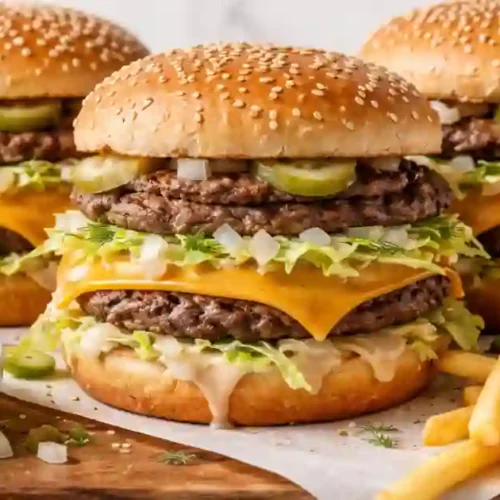
Copycat McDonald’s Big Mac

Ingredients
Burger Components
- 0.5 lb ground beef 80/20 preferred
- 2 whole sesame seed buns with middle layer
- 2 slices American cheese
- 1 cup iceberg lettuce finely shredded
- 0.25 cup dill pickles sliced
- 2 tbsp onion finely chopped
Big Mac Sauce
- 0.5 cup mayonnaise
- 2 tbsp sweet pickle relish
- 1 tbsp yellow mustard
- 1 tbsp white vinegar
- 0.5 tsp paprika
- 0.5 tsp garlic powder
- 0.5 tsp onion powder
Instructions
- Prepare the sauce by mixing mayonnaise, relish, mustard, vinegar, paprika, garlic powder, and onion powder. Let it rest for at least 10 minutes.
- Divide ground beef into 4 thin patties. Press them very thin for authentic texture.
- Heat a skillet over medium-high heat and cook patties for 1–2 minutes per side. Season with salt and pepper.
- Lightly toast the sesame buns until just warm and slightly crisp.
- Assemble the burger starting with the bottom bun, then add sauce, lettuce, cheese, and one patty.
- Add the middle bun layer, then repeat with sauce, lettuce, pickles, onions, and the second patty.
- Top with the final bun layer, gently press together, and serve immediately.
Notes
FAQs About Copycat McDonald’s Big Mac
Why does McDonald’s Big Mac taste different?
Because of consistency and processing. Their ingredients, cooking methods, and even equipment create a very specific flavor that’s hard to fully replicate at home.
Can I freeze Big Mac sauce?
Yes, but it’s not ideal. The texture can separate slightly after thawing. It’s better to make small fresh batches.
What cheese is closest to McDonald’s?
American cheese. Specifically the soft, meltable kind. It behaves differently from most other cheeses.
Can I make this without the middle bun?
You can, but it won’t feel like a true Big Mac. The structure and layering will change noticeably.
Can I make a copycat McDonald’s Big Mac ahead of time?
You can… but it’s not ideal. The biggest issue is texture. Once assembled, the sauce starts soaking into the bun, and the lettuce loses its crunch pretty quickly.
If you’re planning ahead, it’s better to prep everything separately:
Cook the patties and store them in the fridge
Make the sauce in advance
Chop lettuce and onions ahead of time
Then assemble right before eating. It only takes a few minutes, and the difference in freshness is honestly noticeable.
What’s the closest way to replicate the real McDonald’s Big Mac taste at home?
If you’re trying to get as close as possible to the original Big Mac taste, focus on these three things:
Keep the patties very thin
Use American cheese, not substitutes
Balance the sauce carefully
Most people assume it’s about special ingredients, but it’s really about restraint. Not overbuilding it. Not “improving” it too much.
Actually, this might sound strange, but the more you try to make it gourmet, the further you get from the real thing. The goal isn’t perfection. It’s familiarity.
Final Verdict: Is Homemade Big Mac Worth It?
So… is making a copycat McDonald’s Big Mac actually worth it?
Honestly, it depends on what you’re looking for.
If you want convenience, the drive through still wins. No question.
But if you’re curious, or just tired of wondering whether you could make it better at home, then yes. It’s worth trying at least once.
There’s something oddly satisfying about getting close to that familiar flavor. Maybe not identical, maybe even slightly different in ways you didn’t expect. But still recognizable.
And once you figure it out, you start noticing details you never paid attention to before.
Which, now that I think about it, might be the real reason to try this in the first place.
Not just to copy it. But to understand it.
For delicious and easy recipes, follow me on my Facebook and Pinterest
This recipe was written and tested by Rasha, the founder of Recipesedeas. Rasha is a food enthusiast living in the USA, sharing her family-inspired recipes and culinary adventures