
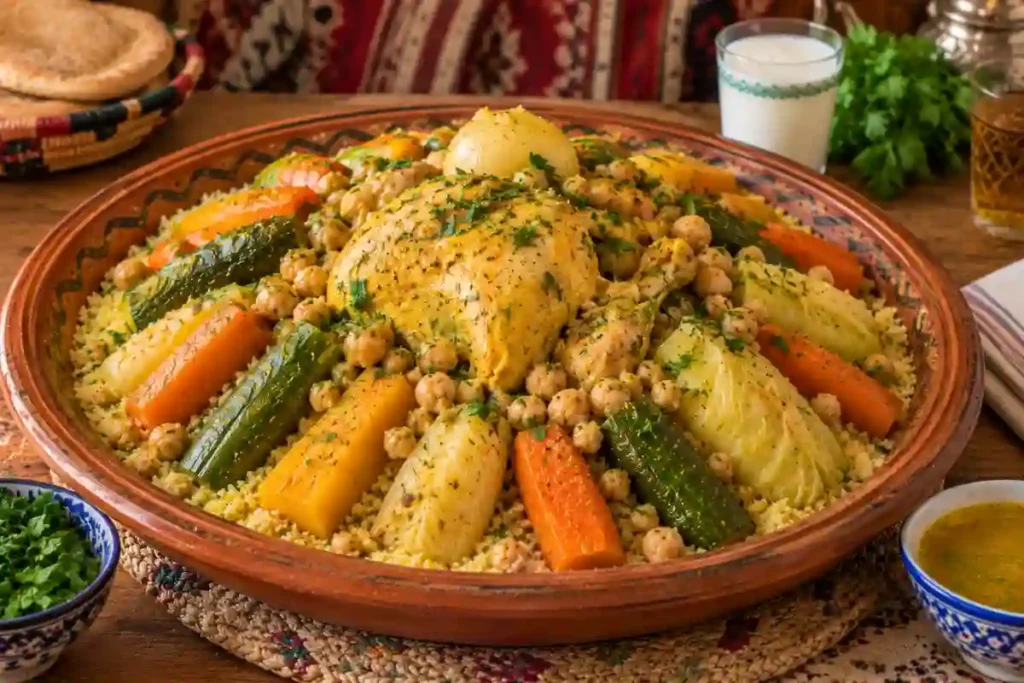
This Moroccan Chicken Couscous is my family’s real Friday recipe from Casablanca. My mom taught me how to triple-steam it to make it fluffy, the day starts the same. No alarm. Just the sound of the couscoussier on the stove and the smell of onions and ginger. I grew up watching her make chicken couscous, not measuring with cups, but with her hands and eyes. When I moved to my own kitchen, I realized no written recipe ever tasted like hers until I started cooking it exactly the way she taught me.
This is not the quick 10-minute boxed couscous. This is the real Friday couscous. The one we steam three times, the one we serve on a big round plate in the middle of the table, the one that takes time but never feels complicated once you learn the rhythm.
If you tried couscous before and it was heavy or sticky, this method will change everything for you.
Table of Contents
Table of Contents
My Family’s Friday Chicken Couscous – The Way My Mom Makes It

Equipment
- Couscoussier or large pot with a steamer basket
- Large wide serving bowl (gsaa or tassa)
- Large round serving platter
- Cutting board
- Chef’s knife
- Grater
- Measuring cups and spoons
- Kitchen string
- Ladle
Ingredients
Couscous
- 500 g medium semolina couscous Use traditional medium couscous, not fine or instant couscous.
- 1 cup warm water Approximately; add gradually in several stages, with a little salt.
- 3 tablespoons olive oil For rubbing into the couscous, plus more for finishing if desired.
- 1 teaspoon smen or butter Use butter if smen is unavailable.
Chicken and Marqa Broth
- 1 whole chicken Cut into 6 pieces, or use 8 bone-in chicken thighs; keep the skin.
- 1 large onion Finely chopped.
- 2 large ripe tomatoes Grated; do not replace with tomato paste.
- 1 cup dried chickpeas Soak overnight and drain before using.
- 1 small bunch fresh parsley and cilantro Tie together with kitchen string to make a rbita.
- 4 tablespoons olive oil For browning the chicken and cooking the broth.
- 2 liters water Approximately, or enough to cover the chicken and chickpeas.
Vegetables
- 3 medium carrots Peeled and cut in half lengthwise.
- 2 whole turnips Peeled and quartered.
- 300 g pumpkin Cut into a large piece or several large chunks.
- 2 medium zucchini Keep whole if small; otherwise cut into large pieces.
- 1/4 small head white cabbage Cut into a large wedge and keep the core intact.
- 1 large onion Cut in half for the broth.
Spices and Seasoning
- 1 teaspoon ground turmeric
- 1 teaspoon ground ginger Use ground ginger rather than fresh ginger.
- 1 teaspoon black pepper
- 1/2 teaspoon white pepper Optional.
- to taste salt Season the broth generously so the couscous absorbs enough flavor.
Instructions
- Heat 4 tablespoons of olive oil in the bottom of a couscoussier over medium heat. Add the finely chopped onion and chicken pieces. Let the chicken brown slightly on the skin for 5–6 minutes, turning as needed.
- Add the turmeric, ground ginger, black pepper, optional white pepper, salt, and grated tomatoes. Stir and cook for about 30 seconds to release the spices’ aroma.
- Add the soaked and drained chickpeas and the tied bunch of parsley and cilantro. Pour in approximately 2 liters of water, or enough to cover the chicken and chickpeas. Bring to a boil, then reduce to a gentle simmer.
- After 20 minutes, add the carrots, turnips, and halved onion. Simmer for another 30 minutes, tasting the broth and adjusting the salt as needed.
- While the broth simmers, place the dry couscous in a large wide bowl. Sprinkle about one-third cup of salted warm water over it gradually, gently rubbing the grains between your palms to separate them.
- Add 3 tablespoons of olive oil and gently rub the couscous for about 2 minutes until the grains feel loose and separate rather than clumpy.
- Transfer the couscous to the steamer basket without pressing it down. Make a small hole in the center to let the steam circulate. Place the basket over the simmering broth and seal any gaps around the rim with a clean cloth if needed.
- Steam the couscous for 20–25 minutes, until steam rises through the top of the grains.
- Carefully remove the steamer and pour the couscous back into the wide bowl. Sprinkle another one-third cup of salted warm water over it, add a little olive oil if desired, and gently fluff with your hands, breaking up any clumps.
- Return the couscous to the steamer and steam for another 20 minutes. During this second steaming, add the zucchini, pumpkin, and cabbage wedge to the broth. Cook the vegetables for approximately 20–25 minutes, until tender but not falling apart.
- Remove the couscous from the steamer again and return it to the bowl. Sprinkle over the final approximately one-quarter cup of warm water and add the teaspoon of smen or butter. Gently fluff the grains until they are light and separate.
- Steam the couscous for a final 15 minutes. Check that the grains are fluffy and separate, then remove from the heat.
- To serve, spread the couscous onto a large, flat round platter and shape it into a mound with a shallow well in the center. Spoon 2–3 ladles of broth over the grains to moisten them.
- Arrange the chicken pieces in the center and place the carrots, turnips, zucchini, pumpkin, cabbage, and onion around them. Scatter the chickpeas over the top and add a little more broth around the platter. Serve extra broth separately so everyone can add more to taste.
Notes
Why We Only Make Couscous on Friday
In Morocco, Friday is couscous day. After Jumu’a prayer, the whole family comes home. My mom would already have the broth simmering since morning. My dad would bring fresh bread, and we would all eat from one big gsaa.It is not just about food. It is about slowing down. In our house, couscous means no one is in a hurry. You sit, you eat slowly, you add more broth if you want, you talk. That is why we never make it on a busy Tuesday. It deserves a Friday.When I make it now in my own home, I still keep that same rule. I start late morning, I put on some Fayrouz, and I let it take its time.
The Ingredients – My Mom’s Exact List
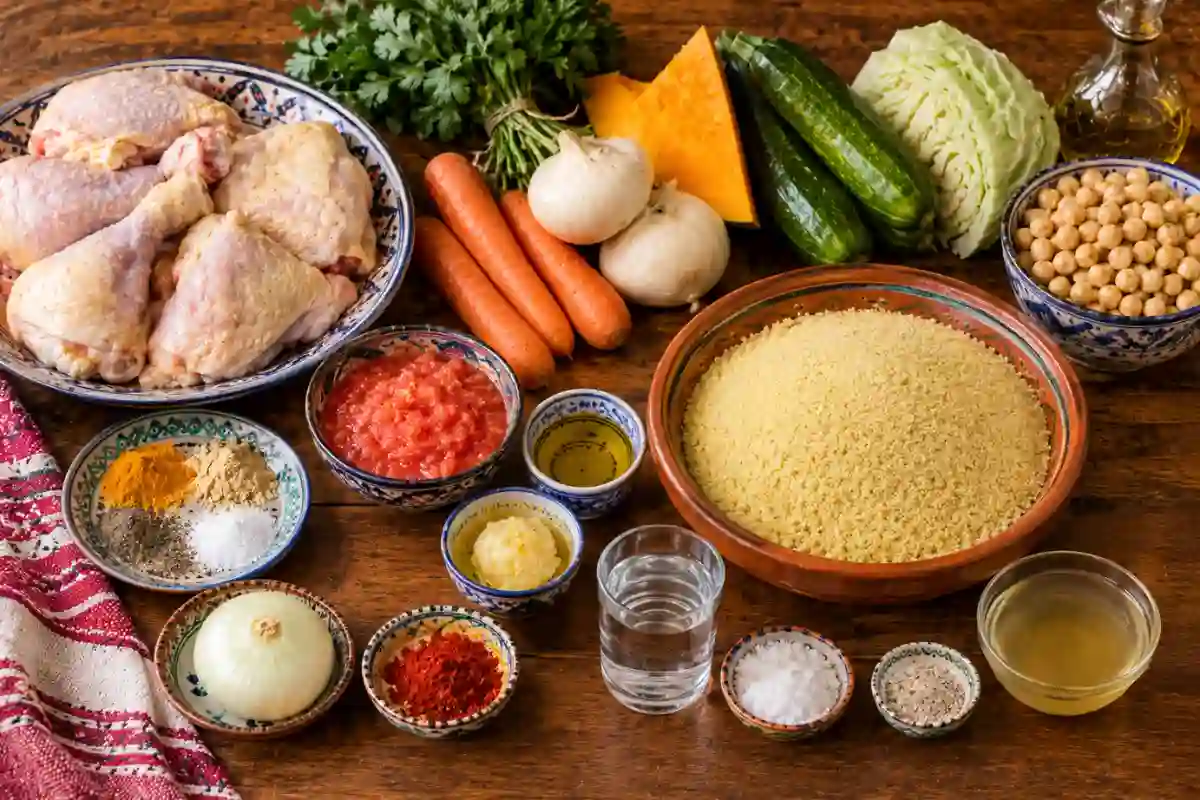
Here are the exact ingredients for this Moroccan Chicken Couscous, just like my mom makes it. I will give you measurements, but my mom never uses a measuring cup. She uses a small glass tea glass. I converted it for you.
For the Couscous itself:
500g medium semolina couscous – not fine, not instant. Look for “moyen” on the bag. If you can only find instant, this recipe will not work the same.
Warm water with a little salt – about 1 cup total, but you add it little by little
3 tablespoons olive oil, plus more for finishing
1 teaspoon smen if you have it. If not, use butter. My mom always says smen makes the smell better.
For the Chicken and Marqa (Broth):
1 whole chicken, cut into 6 pieces, or 8 chicken thighs bone-in. Keep the skin.
1 very large onion, chopped finely, not sliced
2 large ripe tomatoes, grated. This is my mom’s secret, she never uses tomato paste, only fresh grated tomato for color.
1 cup dried chickpeas, soaked overnight. Please don’t use canned, they get too soft and fall apart.
A small bunch of parsley and cilantro, tied together with a string. We call this rbita.
Olive oil for the pot
Vegetables – The 7 Vegetables, But Use What You Have:
3 medium carrots, peeled and cut in half lengthwise
2 turnips, peeled and quartered
1 small piece of pumpkin – about 300g – we call it l’gr3a hamra
2 medium zucchini, keep them whole if they are small
1/4 of a small white cabbage, cut into a big wedge. Keep the core so it doesn’t fall apart.
1 large onion, cut in half, for the top
Spices – Simple, Not Complicated:
1 teaspoon turmeric
1 teaspoon ground ginger – fresh is not the same here, use powder
1 teaspoon black pepper
1/2 teaspoon white pepper if you have it
Salt. Be generous. Couscous needs salt.
We don’t use Ras El Hanout for chicken couscous in my family. Only turmeric, ginger, pepper. That is it. When you add too many spices, you lose the taste of the vegetables.
Equipment You Really Need
The best tool is a couscoussier – the two-part pot. The bottom is for the broth, the top is the steamer with holes. If you don’t have one, you can use a large pot and a steamer basket that fits tightly on top. Put a long piece of clean cloth or aluminum foil around the edge to seal the steam. It is not perfect, but it works. I used a regular steamer for two years before I bought my couscoussier.
You also need a very large wide bowl – we call it gsaa or tassa. You will use it to roll the couscous.
This is how we make this Moroccan Chicken Couscous fluffy, not sticky. It takes three steams.
How to Make It Step by Step – The Rhythm of Three Steams
Step 1: The Broth – Let It Take Its Time (1 hour)
In the bottom of your couscoussier, heat 4 tablespoons olive oil on medium heat. Add the chopped onion and the chicken pieces. Don’t stir too much. Let the chicken get a little golden on the skin, about 5-6 minutes. Then add your spices – turmeric, ginger, black pepper, salt – and the grated tomatoes. Stir so the spices toast for 30 seconds. You will smell it right away.
Add the soaked chickpeas, the rbita of parsley and cilantro, and cover everything with water – about 2 liters. Bring it to a boil, then lower to a soft simmer. After 20 minutes, add the hard vegetables first: carrots, turnips, and the whole onion half. These need time. Let it simmer another 30 minutes.
This is when my mom always tastes the marqa. She takes a small spoon and sips the broth. It should be a little saltier than you think, because the couscous will absorb it later. If it is bland now, it will be bland forever.
Step 2: The First Steam – Waking Up The Grains (25 minutes)
While the broth simmers, put your dry couscous in the big gsaa. Sprinkle about 1/3 cup of salted warm water over it. Not too much. With your hands, gently rub the grains between your palms, like you are washing them. You will feel the grains separate. Add the 3 tablespoons olive oil and keep rubbing gently for 2 minutes. The grains should feel loose, not clumpy.
Put the couscous into the top part of the couscoussier. Don’t press it down. Make a little hole in the middle with your finger so steam can come through. Place it on top of the simmering broth. If you see steam escaping from the sides, seal it with a cloth.
Steam for 20-25 minutes, until you see steam coming out through the top of the couscous.
Step 3: The Second Steam – The Most Important One (25 minutes)
Take the steamer off and pour the couscous back into the gsaa. It will be very hot, so be careful. My mom uses a spoon at first, then her hands when it cools a little. Sprinkle another 1/3 cup salted warm water, and add a little more olive oil. Now fluff it again, breaking any clumps with your fingers. Be gentle. You are not kneading bread. You are separating pearls.
You will notice it already feels lighter and bigger than before.
Put it back to steam a second time for another 20 minutes. During this time, add your softer vegetables to the broth: zucchini, pumpkin, and cabbage wedge. They only need 20-25 minutes.
Step 4: The Third Steam – Finishing (15 minutes)
One last time, pour it back into the bowl. Sprinkle the last bit of water, maybe 1/4 cup this time, and add that teaspoon of smen or butter. Fluff one more time. This is when it should feel incredibly light and fluffy. If you take a pinch, each grain should fall separately.
Steam one final time for 15 minutes. That’s it. Three steams. That is the secret that no boxed couscous can give you.
How to Serve Like a Moroccan Family
Don’t use small individual plates. Find your biggest, flattest round plate.
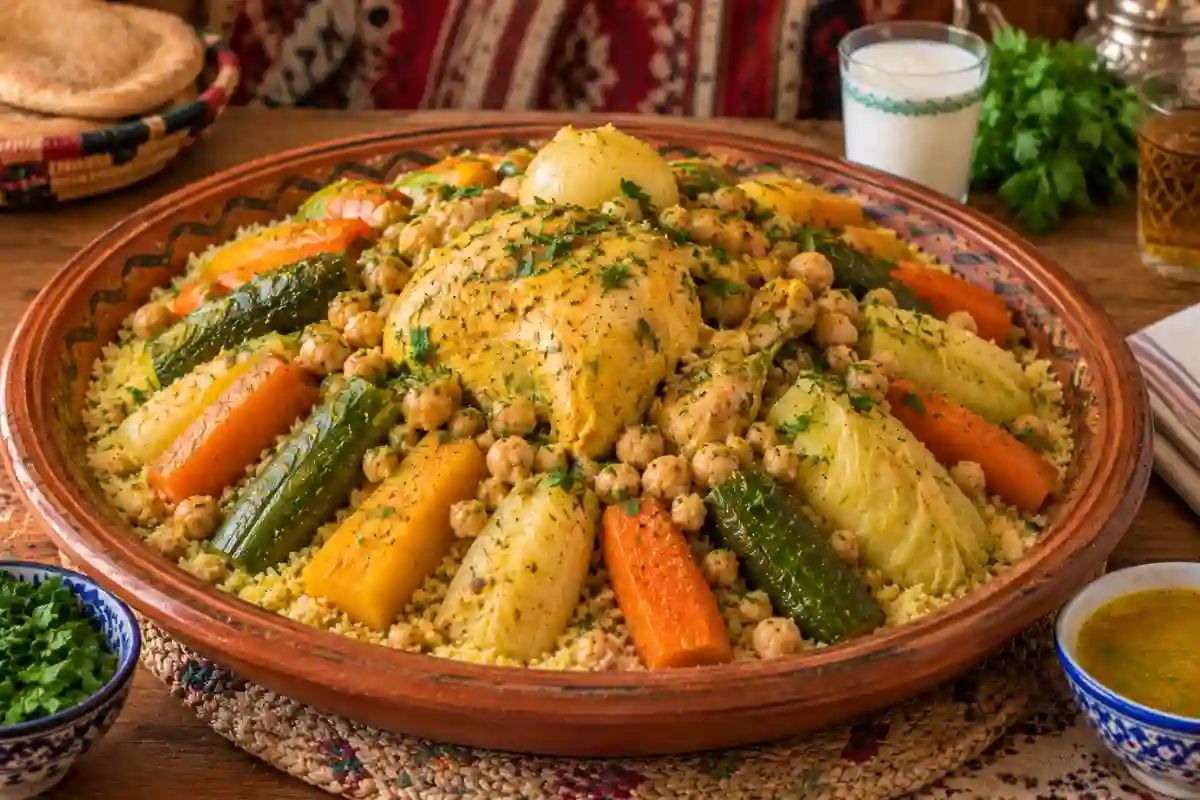
First, put all the couscous in the plate and make a little well in the middle. My mom shapes it with her hands into a small mountain, then flattens the top. Add a ladle of broth over the couscous – not too much, just to make it moist, maybe 2-3 ladles.
Then place the chicken pieces in the center. Arrange the vegetables around it beautifully – carrots together, zucchini together, so it looks abundant. Put the chickpeas over everything. Finally, pour a little more broth on the sides.
We always serve extra broth in a separate bowl on the table. Everyone adds more as they like. And we eat with spoons, from the same plate. If you have guests, let them see you bring the whole plate to the table. That moment is everything.
We drink it with buttermilk – lben – and after, always mint tea.
Mistakes I Made When I Started
I made all of these, so you don’t have to.
I used too much water at once. My first couscous was like dough. My mom laughed and said “you drowned it”. Add water slowly, little by little. You can always add, but you can’t take away.
I stirred the couscous with a spoon and broke the grains. Use your fingers, gently.
I added zucchini at the beginning. It disappeared in the broth. Soft vegetables always go in the last 20 minutes.I was scared to salt enough. The broth must be well-salted. The couscous itself has no flavor, it drinks the broth.
How I Store Moroccan Chicken Couscous
In Morocco we rarely have leftovers because we make just enough, but if you do:
Keep the couscous and the broth in separate containers. If you leave them together, the couscous will soak up all the broth overnight and become mushy.
In the fridge, both keep for 3 days. To reheat, sprinkle a few tablespoons of water on the couscous and steam it again for 5 minutes, or microwave covered with a damp paper towel. Reheat the broth on the stove. Don’t freeze the couscous if you can avoid it, it changes the texture. The broth with chicken freezes perfectly for 3 months.
Frequently Asked Questions About Moroccan Chicken Couscous
Can I use lamb instead of chicken?
Yes, and in many families lamb is even more traditional for celebrations. Use lamb shoulder with bone, and cook it longer – add an extra 30 minutes to the first simmer before adding carrots. Chicken is what we use for most Fridays because it is lighter and faster.
Why do you tie the parsley and cilantro?
So you can take it out easily. If you chop it and leave it in, it makes the broth dark and bitter after a long time. Tied together, it gives flavor but you remove it before serving.
My couscous is still dry after three steams, what did I do wrong?
You probably didn’t add enough water during the fluffing steps, or your steam was escaping. Next time add an extra 2-3 tablespoons of water each time you fluff, and make sure the seal between the two pots is tight.
Can I make Moroccan chicken couscous without a couscoussier?
Yes, you can. While a traditional couscoussier gives the most authentic texture because the steam circulates evenly through the semolina, a large pot with a tight fitting steamer basket works surprisingly well. The key is sealing the edges so steam does not escape. You can wrap a clean kitchen towel around the rim before placing the lid. The result may not be identical to the classic Moroccan method, but it will still be light, fluffy, and deeply flavorful if you follow the triple steaming process carefully.
Why is couscous steamed three times instead of once?
Steaming Moroccan chicken couscous three times allows the grains to hydrate gradually without becoming sticky or dense. After each steam, you fluff and moisten the couscous slightly, which separates the grains and improves texture. If you only steam it once, the inside may stay dry while the outside turns mushy. The repetition might seem excessive at first, but this technique is what gives traditional Moroccan couscous its signature airy consistency.
What vegetables are traditionally used in Moroccan chicken couscous?
Classic Moroccan couscous often includes carrots, zucchini, pumpkin or squash, turnips, cabbage, chickpeas, and onions. However, the exact combination can vary depending on season and region. Some families add sweet potatoes or fava beans. The idea of “seven vegetables” symbolizes abundance rather than strict rules. As long as you balance root vegetables with softer ones and cook them in stages, you will achieve an authentic and well structured result.
Conclusion
Authentic Moroccan chicken couscous is not fast food. It requires attention, repetition, and patience. But that is precisely what makes it meaningful. Each steaming builds texture. Each vegetable adds depth. Each spoonful carries history from Morocco to your table.
If you were searching for a traditional Moroccan chicken couscous recipe that balances authenticity with clarity, this method delivers both. Once you try it the traditional way, it is difficult to go back to shortcuts.
If you loved this slow-cooked Moroccan Chicken Couscous, you will also love my Beef Tagine with Prunes.
For more delicious and easy recipes, follow me on Facebook and Pinterest
If you enjoyed this recipe, feel free to leave a comment below or follow me on my culinary journey!
This recipe was written and tested by Rasha, the founder of Recipesedeas. Rasha is a food enthusiast living in the USA, sharing her family-inspired recipes and culinary adventures