
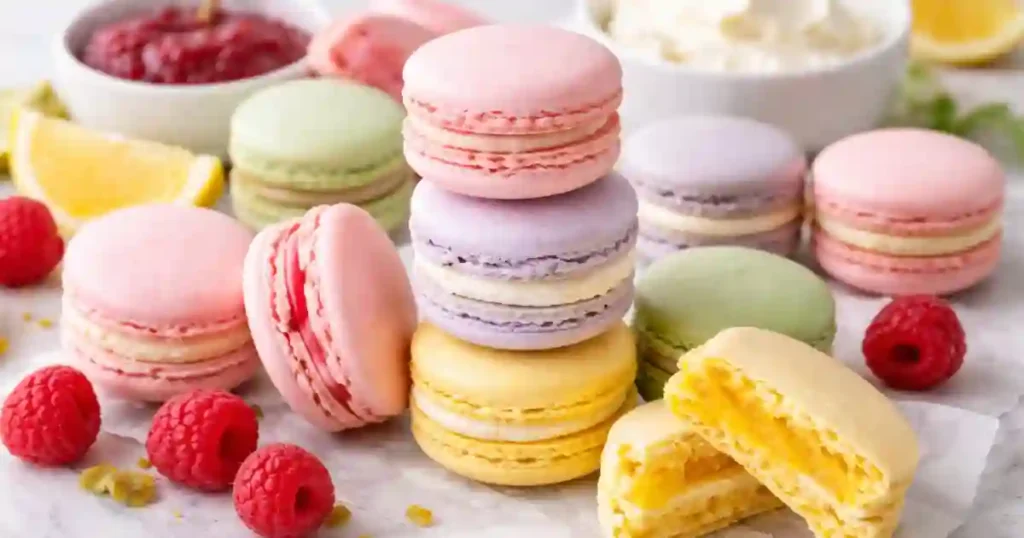
French Macarons Recipe (Step-by-Step for Beginners)
If you’ve been searching for a French macarons recipe that actually works, not just in theory but in a real kitchen with real mistakes, you’re in the right place.
Let’s be honest for a second. Macarons have this reputation that feels almost personal. Like, you follow the steps, measure everything perfectly, and somehow they still crack, spread, or come out hollow. It’s frustrating in a very specific way. Not dramatic, just quietly annoying.
So here’s the direct answer upfront, the one Google likes and you probably need right now:
French macarons are delicate almond meringue cookies made by folding almond flour and powdered sugar into whipped egg whites, then piping and baking them until they form smooth shells with signature “feet.”
Table of Contents
Table of Contents
Why You’ll Love This French Macarons Recipe
- Quick to understand once you “see” the process, even if it looks intimidating at first
- Uses simple, minimal ingredients you probably already have
- Designed specifically for beginners who are tired of failed batches
- Helps you finally get those smooth tops and perfect macaron feet
- Perfect for special occasions, gifting, or honestly just proving to yourself you can do it
- Balanced sweetness with that light, delicate texture that feels almost bakery-level
There’s something oddly satisfying about getting macarons right. Not just because they taste good, but because they’re known for being difficult. This version focuses less on perfection and more on control, which, ironically, is what gets you closer to perfect results.
Simple on paper. Not so simple in practice.
This guide is different because it doesn’t just tell you what to do. It shows you how to think while doing it. That tiny shift is usually what separates a failed batch from a perfect one.
Step-by-Step Overview
- Sift almond flour and powdered sugar together
- Whip egg whites to stiff peaks
- Fold dry ingredients into meringue (macaronage)
- Pipe circles onto baking tray
- Rest until a skin forms
- Bake at controlled temperature
- Cool completely before removing
That’s the structure. But the real magic, and the real problems, happen in the details. And yeah, we’ll get into those.
What you’re probably thinking right now
“Okay, but why do mine always fail even when I follow steps like this?”
Good question. Actually, that’s the whole point of the next section.
Why French Macarons Are So Hard to Make
There’s a reason the phrase “hardest cookie to bake” keeps popping up around French macarons recipe searches.
It’s not just technique. It’s tension.
Macarons sit in this awkward space between baking science and human instinct. You’re expected to be precise, but also intuitive. That contradiction trips most people up.
The real reasons macarons fail
- They react to humidity more than most baked goods
- The mixing stage is not fixed, it is judged visually
- Oven temperature variations matter more than usual
- Small mistakes compound quickly
And here’s something most guides don’t say clearly.
You can do everything “right” and still fail if you don’t recognize what the batter should feel like.
That’s where people start doubting themselves. Was it overmixed? Undermixed? Oven too hot? Honestly, sometimes it’s all of those at once.
The mental shift that helps
Instead of thinking:
“I need to follow the recipe perfectly”
Try:
“I need to understand what each step is trying to achieve”
That sounds subtle, but it changes everything.
Ingredients for French Macarons (And Why They Matter)
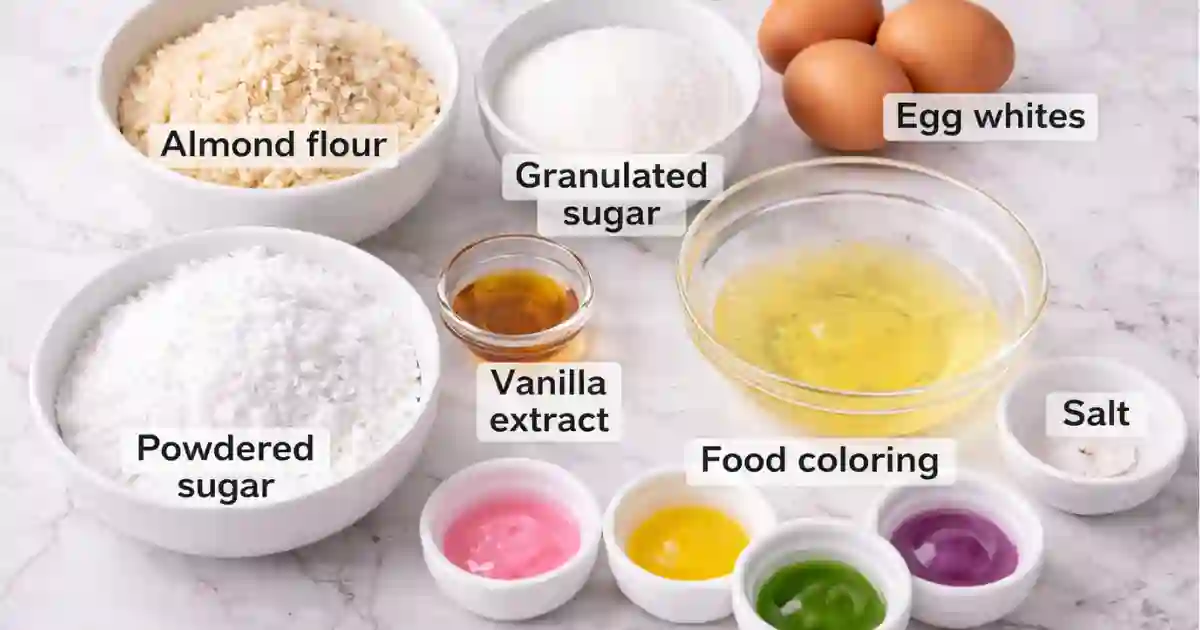
A good French macarons recipe is built on very few ingredients. That’s part of the problem. There’s nowhere to hide mistakes.
Core ingredients
- Almond flour
- Powdered sugar
- Egg whites
- Granulated sugar
That’s it. Four ingredients. Which feels almost suspicious, right?
Why each ingredient matters
Almond flour
It defines the texture. Too coarse and your shells look rough. Too oily and they collapse. This one ingredient alone can quietly ruin a batch.
Powdered sugar
Adds sweetness and structure. It also helps create that smooth top. Skipping proper sifting here is one of those small shortcuts that backfires.
Egg whites
This is your structure and air. If they’re under-whipped, your macarons spread. Over-whipped, and they become dry and unstable.
Granulated sugar
Stabilizes the meringue. Without it, the structure collapses faster than you’d expect.
Subtle mistakes people make
- Not sifting dry ingredients properly
- Using egg whites straight from the fridge
- Ignoring humidity in the kitchen
- Assuming all almond flour behaves the same
Do I need to age egg whites?
Aging egg whites can help reduce moisture and create a more stable meringue, but it is not strictly required. Many bakers get consistent results using fresh egg whites once they understand the technique.
Macaronage Technique Explained (Critical Step)
If there’s one part of a French macarons recipe that feels like guesswork, it’s this one.
Macaronage.
Even the word sounds intimidating. But the idea is simple. You are folding the batter until it flows just enough.
Not too stiff. Not too runny.
Somewhere in between that’s hard to describe and annoyingly easy to miss.
What proper macaronage looks like
The batter should fall in slow ribbons from your spatula. When it hits the bowl, it should blend back into itself within about 10 seconds.
If it sits like a lump, it’s undermixed.
If it disappears instantly, it’s overmixed.
And yeah, that window is small.
What it feels like in real life
This is the part where people hesitate.
You mix. You stop. You second guess. You mix again. Suddenly it’s too late.
Actually, scratch that. Most failures happen because people are afraid of overmixing, so they stop too early.
Practical tip
Use fewer folds than you think, then test the flow. Repeat gradually.
It’s slower, but it works.
Can you fix overmixed batter?
No, overmixed macaron batter cannot be fixed. Once it becomes too runny, the structure is lost and the macarons will spread and bake flat.
Common French Macaron Mistakes (And Fixes)
This is where most people land after a failed French macarons recipe attempt.
Let’s go through the most common issues without overcomplicating it.
Cracked shells
Cause:
- No resting time or weak skin formation
- Oven too hot
Fix:
- Let macarons rest until dry to the touch
- Lower oven temperature slightly
No feet
Cause:
- Undermixed batter
- Weak meringue
Fix:
- Improve macaronage technique
- Whip egg whites properly
Hollow macarons
Cause:
- Overmixed batter
- Overbaking or unstable meringue
Fix:
- Adjust mixing consistency
- Slightly reduce baking time
Sticky bottoms
Cause:
- Underbaking
- Humidity
Fix:
- Bake a bit longer
- Let them cool fully before removing
Macaron Troubleshooting Guide (Fix Every Issue Fast)
Here’s a simplified version you can actually use mid-baking.
Quick fixes
- Batter too thick → fold a few more times
- Batter too runny → start over, unfortunately
- Shells cracking → rest longer before baking
- No feet → check meringue strength
- Uneven shapes → improve piping consistency
What most people don’t realize
Sometimes it’s not just one mistake. It’s a chain reaction.
Slightly undermixed batter + slightly high oven temp = completely failed batch.
That’s why improving one variable at a time works better than changing everything at once.
French vs Italian Macarons (Which Is Better?)
If you’ve spent more than five minutes researching a French macarons recipe, you’ve probably seen this debate.
French method vs Italian method.
French method
- Simpler
- Fewer steps
- Less stable
Italian method
- Uses sugar syrup
- More stable meringue
- Slightly more complex
Here’s the honest take.
French macarons are harder, but they teach you more. Once you master them, everything else feels easier.
Italian macarons are more forgiving, but they can feel a bit technical.
So which is better?
It depends on what you want. Control or simplicity.
Pro Tips for Perfect French Macarons Every Time
By now, you’ve probably realized that a French macarons recipe is less about ingredients and more about control.
Here are the tips that actually make a difference.
Real-world tips
- Bake in the middle rack for even heat
- Tap trays to release air bubbles
- Rotate trays if your oven has hot spots
- Avoid baking on very humid days if possible
Less obvious advice
- Stop chasing perfection too early
- Expect your first few batches to fail
- Focus on consistency, not perfection
That last one matters more than it sounds.
Because once you get consistent results, improving them becomes much easier.
Serving and Storage Tips
Serving Suggestions for French Macarons Recipe
Macarons look impressive on their own, but a few small touches make them feel next-level:
- Serve on a clean, minimal plate to highlight their colors
- Pair with coffee, espresso, or tea for contrast
- Stack them slightly off-balance for a more natural, bakery-style presentation
- Add a light dusting of powdered sugar if you want a softer visual finish
If you’re serving guests, this is one of those desserts that quietly steals attention. People notice.
Storage Tips for French Macarons Recipe
- Store macarons in an airtight container in the refrigerator for up to 5 days
- Let them sit at room temperature for about 20 minutes before serving for best texture
- For longer storage, freeze them in an airtight container for up to 1 month
Reheating isn’t really a thing here, but bringing them back to room temperature makes a big difference. Cold macarons can feel a bit too firm, almost like they’re holding back.
Helpful Notes (Read This Before Your Next Batch)
- If your kitchen is humid, expect longer resting times. Sometimes a lot longer
- Don’t rush the macaronage stage. Most issues start there
- Oven temperature is rarely as accurate as you think, so small adjustments matter
- Your first batch might fail. Actually, it probably will. That’s normal
You might feel like you’re doing everything right and still getting inconsistent results. That’s part of the process. Over time, you start noticing patterns. Batter texture, baking time, even how the shells look before going into the oven.
That awareness is what changes things.
Variations to Try
- Add vanilla, almond, or citrus extracts for subtle flavor shifts
- Use food coloring for themed batches or events
- Experiment with fillings like chocolate ganache, buttercream, or fruit jam
Nutrition Information (Per Serving – Approximate)
- Calories: 90 to 110
- Carbohydrates: 12g
- Sugar: 10g
- Protein: 2g
- Fat: 4g
- Saturated Fat: 1g
- Fiber: 1g
Keep in mind, macarons are more about experience than nutrition. They’re small, rich, and meant to be enjoyed slowly. One or two usually feels just right, even if you’re tempted to keep going.
French Macarons Recipe (Step-by-Step for Beginners)

Ingredients
Macaron Shells
- 100 g almond flour finely sifted
- 100 g powdered sugar sifted
- 100 g egg whites room temperature, about 3 large egg whites
- 100 g granulated sugar for stabilizing meringue
Optional Flavoring & Filling
- 1 tsp vanilla extract optional
- 120 g chocolate ganache, buttercream, or fruit jam for filling
Instructions
- Preheat the oven to 150°C (300°F). Line a baking tray with parchment paper or a silicone baking mat.
- Sift the almond flour and powdered sugar together into a bowl. Repeat once more if needed to ensure a fine, lump-free mixture.
- In a clean, dry bowl, whip the egg whites using an electric mixer until foamy. Gradually add the granulated sugar and continue whipping until stiff, glossy peaks form.
- Gently fold the dry ingredients into the meringue using a spatula. Continue folding until the batter flows in slow ribbons and blends back into itself within about 10 seconds.
- Transfer the batter into a piping bag fitted with a round tip. Pipe small circles onto the prepared tray, leaving space between each shell.
- Tap the tray firmly on the counter several times to release trapped air bubbles. Pop any visible bubbles with a toothpick.
- Let the piped shells rest at room temperature for 20 to 60 minutes, or until the tops feel dry to the touch and a skin has formed.
- Bake for 14 to 15 minutes on the middle rack. The macarons are done when the shells are firm and do not wobble when lightly touched.
- Allow the shells to cool completely before removing them from the tray.
- Pair similar-sized shells and fill with ganache, buttercream, or jam. Sandwich gently and refrigerate for 24 hours for best texture before serving.
Notes
FAQs About French Macarons Recipe
Why do macarons fail so often?
Because they require precise control over mixing, moisture, and temperature, making small mistakes more impactful.
Can I make macarons without almond flour?
Traditional French macarons require almond flour. Substitutes usually change the texture and structure significantly.
How do I store macarons?
Store them in an airtight container in the refrigerator for up to 5 days.
Why do French macarons crack?
Cracked macarons usually happen because the shells did not form a proper skin before baking or the oven temperature was too high. It can also be caused by trapped air bubbles in the batter.
Why are my macarons hollow inside
Hollow macarons are usually caused by overmixing the batter or baking at incorrect temperatures, which prevents proper internal structure from forming.
How do I know when macarons are done baking?
Macarons are done when they have firm shells and do not wobble when gently touched. The bottoms should release cleanly from the baking surface.
Which macaron method is best for beginners?
The French method is simpler to start with, but the Italian method offers more stability. Beginners can succeed with either, but consistency often comes faster with the Italian method.
How long should macarons rest before baking?
Macarons should rest for 20 to 60 minutes, depending on humidity, until a dry skin forms on the surface.
Conclusion
Mastering a French macarons recipe is not about getting lucky. It’s about slowly understanding what each step is doing and learning to recognize when something feels off.
At first, it can feel like guesswork. Then it starts to make sense. And eventually, almost without noticing, you stop following instructions and start trusting your judgment.
That’s usually the moment when macarons finally turn out the way you expected.
Not perfect every time. But close enough that you stop worrying about it.
And honestly, that’s when baking becomes fun again.
For delicious and easy recipes, follow me on my Facebook and Pinterest
